



History of the basilica
Moments carved in time in our basilica
From the Origins to the Middle Ages
The basilica was built by Constantine around 325-326 and, according to some scholars, was named after the emperor's sister, Anastasia (281–post 314), while others believe it was dedicated to the cult of Anastasia (i.e., resurrection). However, towards the end of the 5th century, it was likely dedicated to Saint Anastasia of Sirmium, a Roman woman and martyr of the 3rd century, as documented in the acts of the synod of 499, where the church was registered with the titulus Anastasiae.
The church was built on the southwestern slopes of the Palatine—the hill on which the imperial palace stood—on pre-existing Roman structures:
a portico, dating from between the end of the Republican era and the 6th century, and a massive residential building (insula) with shops (tabernae) on the ground floor, which backed onto the Palatine and faced the Circus Maximus;
the remains of a building dating back to the 1st century, identifiable as the vestibule of the Lupercal, the cave where Romulus and Remus were believed to have been suckled by the she-wolf.
The early Christian basilica was the first to be erected in an area of extreme civil and political importance within the city, while, even after the Edict of Milan in 313, out of the prudence of the authorities aimed at avoiding religious conflicts, the other churches were located in peripheral areas. The proximity to the buildings on the Palatine Hill where imperial representatives exercised administrative power was crucial in electing Santa Anastasia as their official place of worship.
The religious importance of Santa Anastasia is evidenced by the papal celebrations held there: from the time of Saint Gregory the Great (590-604) and for several centuries, the pontiff celebrated the "Dawn Mass" there, one of the three on Christmas Day (the first at midnight in Santa Maria Maggiore and the third in St. Peter's). The Pope returned to the Basilica for the celebration of the Eucharist on the first Tuesday of Lent and again on the Tuesday of Pentecost. Finally, until the 18th century, it was the starting point of the penitential procession, led by the pontiff, on Ash Wednesday, which ended at the Basilica of Santa Sabina, where the first stationary Mass of Lent was celebrated.
According to tradition, the basilica is linked both to the preaching of Pope Saint Leo the Great (440-461), who delivered sermons here against Archimandrite Eutyches (378-454) and the heresy of Monophysitism, and to the work of Saint Jerome (c. 347-420), who brought precious relics from the Holy Land[3] here and celebrated Mass there, living nearby.
During the pontificate of Saint Damasus (366-383), the building was decorated with frescoes and enriched with mosaics by Pope Hilary (461-468).
Over the centuries, the church underwent numerous restorations, which altered its original structure: from those commissioned by the Ostrogothic king Theodoric (495-526) to those of Popes John VII (705-707), Leo III (795-816), Gregory IV (827-844), and Innocent III (1198-1216).
In 1478, at the behest of Sixtus IV (1471-1484), the basilica was renovated and equipped with a tall bell tower.
From the 16th Century to the Present
Between 1598 and 1618, Cardinal Bernardo Rojas de Sandoval (1546-1618) built a new façade, preceded by a large portico. This was destroyed in 1634 by a tornado and rebuilt in 1636, in its current form, by the architect Luigi Arrigucci (c. 1575-1647), at the behest of Pope Urban VIII (1623-1644).
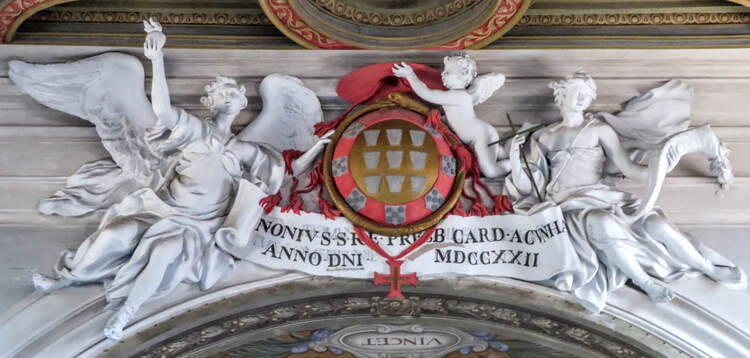
A complete and radical renovation of the interior was carried out in 1721-1722 by the architect Carlo Gimach (1651-1730), commissioned by the Portuguese Cardinal Nuno da Cunha e Ataíde (1664-1750). Further restorations were ordered in the first half of the 19th century by Popes Pius VII (1800–1823) and Pius IX (1846–1878).
The church was restored again in 1963 by order of Cardinal James Francis Louis McIntyre (1886–1979), Archbishop of Los Angeles, and thanks to the contributions of the faithful of Los Angeles, as recorded in an inscription on the floor of the central nave.
In the 1980s, severe structural deterioration and a radical restoration, overseen by the Superintendence of Environmental and Architectural Heritage of Rome, led to the church's closure for over thirty-five years. It was only reopened for daily worship in May 2000.
The basilica is currently a subsidiary church of the parish of Santa Maria in Portico in Campitelli.
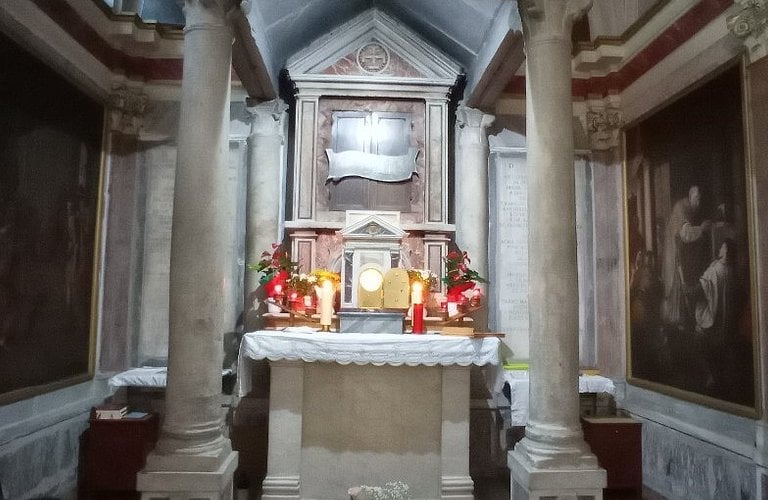
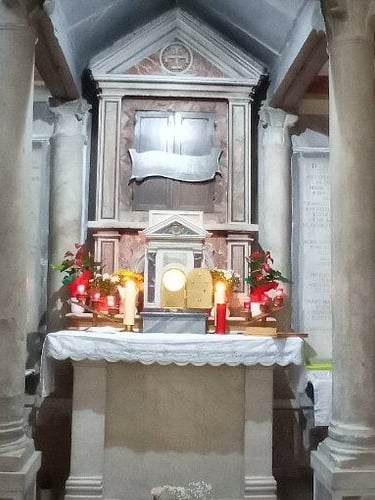
Since March 2, 2001, the church has been open continuously for perpetual Eucharistic Adoration in the Chapel of Saints Jerome and Joseph, at the beginning of the left nave.
On July 8, 2020, Cardinal Angelo de Donatis, Vicar General of Rome, issued a decree assigning this historic church to the Syro-Malabar Church, an Eastern Catholic Church in full communion with Rome and based in Kerala, India.
Basilica di Sant'Anastasia al Palatino
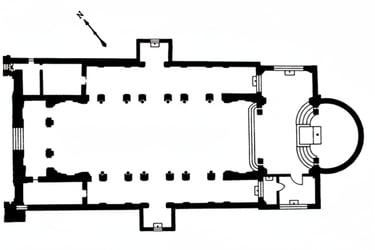
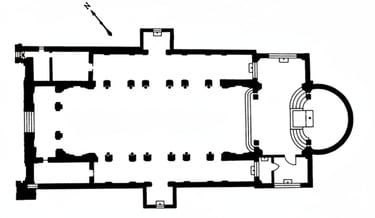
(pianta)
Exterior
The church features a façade with twin bell towers set at the sides. Built of brick with limestone architectural details, it is in the style of Bernini. It has two tiers: the lower, with Doric pilasters, extends in width to include the base of the bell towers; the upper, with Ionic pilasters, ends with a tympanum, crowned by candelabra, with the coat of arms of Pope Urban VIII in relief at the center, decorated with festoons, ribbons, and cornucopias. The façade features a single portal and a rectangular window, both of which are molded.
Interior
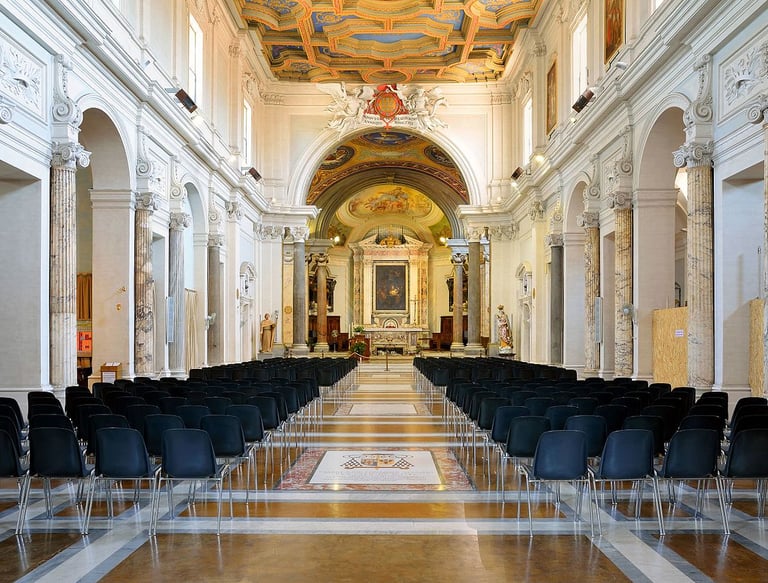
The church, oriented (i.e., with the apse facing east), has a basilical plan ending in a semicircular apse. The interior, divided into three naves by Roman columns with Ionic capitals resting on six pilasters on each side, was richly decorated in 1721-1722 by Carlo Gimach. The side naves are opened in the middle by a rectangular chapel. Note that the transept protrudes slightly beyond the right side, but ends slightly within the line of the left wall.
Central nave
Michelangelo Cerruti, Martyrdom of Saint Anastasia of Sirmium (1722), oil on canvas
The central nave is covered by a fine coffered ceiling, which depicts in the center:
Martyrdom of Saint Anastasia of Sirmium (1722), oil on canvas by Michelangelo Cerruti.
Coat of arms of Popes Pius VII and Pius IX.
Left Aisle
Along the left aisle, the following are noted:
At the beginning of the nave, in the chapel dedicated to Saint Jerome and Saint Joseph, are preserved:
Within a lunette, Martyrdom of Saint Anastasia of Sirmium (second half of the 17th century), fresco, attributed to Lazzaro Baldi and Domenico Ponti.
Ciborium (mid-12th - mid-13th century), in marble and mosaic from the Cosmati workshop;
Saint Jerome Celebrating Mass (first half of the 17th century), oil on canvas, attributed to Domenico Zampieri, known as Domenichino.
Funeral of Saint Anastasia of Sirmium (second half of the 17th century), oil on canvas, attributed to Lazzaro Baldi.
Halfway down the nave, in the chapel dedicated to Saint George, you can see:
Saint George and Saint Publius (second-third quarter of the 18th century), oil on canvas, by Étienne Parrocel.
Left Transept
At the end of the right transept is the altar, dedicated to Our Lady of the Rosary, which houses:
At the altar, Our Lady of the Rosary with Saint Dominic de Guzmán and Saint Catherine of Siena (before 1686), oil on canvas by Lazzaro Baldi.
On the right wall, the funerary monument of Cardinal Angelo Mai (1857), in marble by Giovanni Maria Benzoni.
Presbytery and High Altar
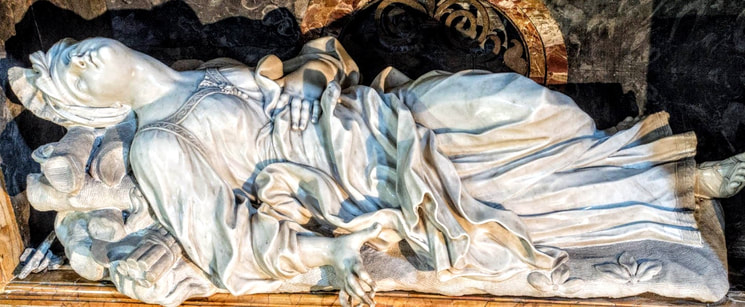
Francesco Aprile, Ercole Ferrata, Saint Anastasia of Sirmium Lying on the Pyre (c. 1685–1690), marble
In the presbytery, designed by Onorio Longhi (1568–1619), raised by several steps, the works preserved include:
Within the altar panel, Adoration of the Shepherds (second half of the 17th century), oil on canvas by Lazzaro Baldi.
Below the altar table, Saint Anastasia of Sirmium (c. 1685–1690), in marble, a work conceived and begun by Francesco Aprile, but completed by Ercole Ferrata upon the artist's death.[8] The statue, which depicts the saint lying on the pyre of martyrdom, is inspired by Bernini's famous sculpture depicting the Ecstasy of Blessed Ludovica Albertoni (1671–1674).
Right Transept
At the end of the right transept is the altar, dedicated to Saint Turibius de Mogrovejo, which houses:
Saint Turibius de Mogrovejo (1726), oil on canvas by Francesco Trevisani.
Right Aisle
Along the right aisle, you can admire:
Halfway down the nave, in the chapel dedicated to Saint John the Baptist, is housed:
At the altar, an altarpiece with Saint John the Baptist in the Desert (c. 1658), oil on canvas by Pier Francesco Mola.
At the beginning of the nave, is the Chapel of the Relics, dating back to the 17th century, where you can see:
On the side walls, a cycle of four paintings with Stories of Saint Charles Borromeo and Saint Philip Neri (c. 1679), oil on canvas by Lazzaro Baldi and workshop.
Source: https://it.cathopedia.org


Apostolic Visitation to Europe
Europe was a favorite destination for Syro-Malabar migrants from Kerala in the second half of the 20th century, with countries such as Austria, France, Germany, Ireland, Italy, Spain, and Switzerland attracting them the most. Initially, there was primarily an influx of healthcare professionals to these countries; later, some also saw a concentration of domestic workers. However, since 2000, IT professionals have begun to see Europe as a preferred destination. Today, we find Syro-Malabar IT professionals and nurses in Belgium, the Netherlands, and Scandinavian countries, university students in Bulgaria, Georgia, Poland, Latvia, and Ukraine, and nurses and domestic workers even in Malta.
Italy is home to a very large number of Syro-Malabar migrant faithful (approximately 12,000), distributed across cities such as Rome, Genoa, Milan, Patti, Savona, Nocera-Pagani, Forlì-Ravenna, Treviso, Florence, Macerata, Siena, etc., working as doctors, nurses, home care workers, domestic supervisors, and workers in restaurants, bakeries, hotels, and factories. With the significant increase in the number of Syro-Malabar Catholics in Rome and other parts of Italy, the president of the Italian Bishops' Conference appointed Father James Pereppadan as National Coordinator in 2000 to facilitate the pastoral care of the Syro-Malabar community in Italy; Father Jose Pollayil (2004) and Father Stephen Chirappanath (2011) were subsequently appointed.
In 2016, Msgr. Stephen Chirappanath, who also served as Procurator of the Syro-Malabar Church to the Holy See and priest responsible for the Syro-Malabar faithful in the Diocese of Rome, was appointed Apostolic Visitor for the Syro-Malabar migrant faithful in Europe, residing at DOMUS MAR THOMA, the Procurator's Office of the Syro-Malabar Church at Via degli Estensi 137, Rome. The purpose of appointing an Apostolic Visitor for the Syro-Malabar faithful in Europe is to assess the situation and needs of the faithful, encourage them, meet with local bishops, and submit a report with proposals to the Congregation for the Oriental Churches. In his letter of appointment, Pope Francis clearly states that the Apostolic Visitor was appointed for his concern for the needs of the Syro-Malabar faithful, many of whom, living in the European region, lack guidance for their spiritual needs.
SYRO-MALABAR COMMUNITY
DIOCESE OF ROME
In the context of the commemorative volume published on the occasion of the silver jubilee of the beginning of the pastoral care of the Syro-Malabar migrant faithful in Rome, Italy, it is appropriate to make special mention of the Syro-Malabar presence. In Rome, until 1993, Syro-Malabar Catholics gathered occasionally on Sundays for the Syro-Malabar Qurbana, organized primarily by CMI priests. Subsequently, on November 7, 1993, at the request of several lay people, the priests of the Damascene College, under the guidance of Father Stephen Chirappanath and Father Francis Kodiyan MCBS, began the regular celebration of Sunday Qurbana in the chapel of the convent of the Oblate Sisters of Bambino Gesù, at Via Urbana 1, guiding the community with pastoral care for a year.
The Syro-Malabar community in Rome received official recognition from the Vicariate of Rome in 1994, thanks to the sincere efforts of Archbishop Abraham Kattumana, Pontifical Delegate of the Syro-Malabar Major Archiepiscopal Church. Consequently, Rev. Fr. George Nedungatt SJ was appointed priest in charge of the Syro-Malabar community in Rome, and the church of Santa Maria in Publicolis, near Torre Argentina, was officially granted to the community. Between 1994 and 2000, Fr. Jose Kaniamparampil (1994), Fr. Sebastian Kalappura (1995), and Fr. James Pereppadan (1997) served as assistants.
Subsequently, it was deemed appropriate to have a full-time priest to serve the community in Rome, and the following were appointed as leaders: Father Job Myladiyil CMI (1999), Father John Poovatholil CMI (2001), Father Jacob Marangatt CMI (2006), Bishop Cherian Kanjirakompil (2008), Bishop Stephen Chirappanath (2011), and Father Cherian Varicattu (2017) until 2019. Father Biju Muttathukunnel (since 2012), Father Binoj Mulavarickal (since 2015), and Father Sanal Malieyckal (since 2017) served as assistants.
Since the inception of the Santhom Pastoral Center, numerous lay faithful have dedicatedly supported the growth of the community, also participating in pastoral administration through the formation of parish committees. For various reasons, the CLC leaders also played a significant role in the smooth running of the parish for many years. Since the Syro-Malabar Qurbana was celebrated in Malayalam, all Malayalis gathered on Sundays; however, in 2006, the Latin and Knanaya communities began Eucharistic celebrations.
Syro Malabar Community
The Basilica of Sant'Anastasia on the Palatine Hill recounts centuries of faith and art in the heart of Rome.
A lively place
Today the basilica is a meeting point for the community, between prayer, art and culture.
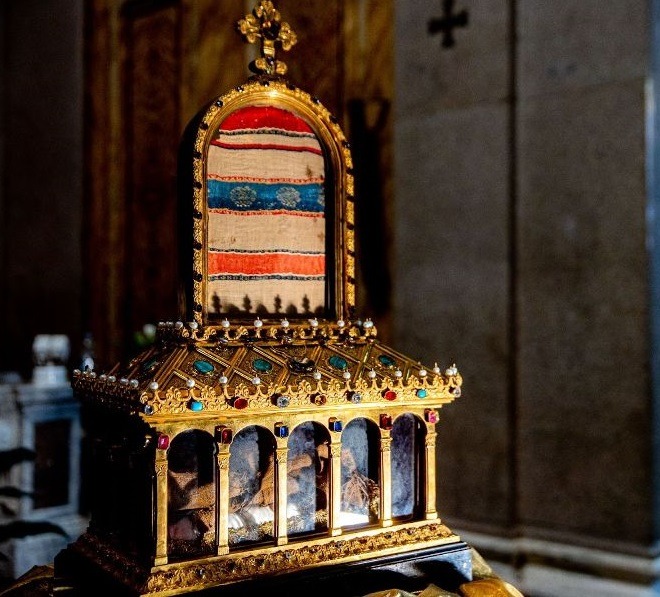
Sacred Mantle of Saint Joseph and Veil of Our Lady
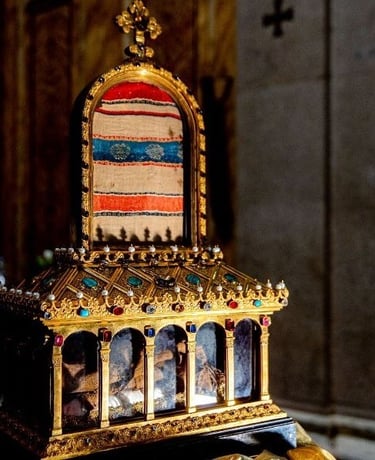
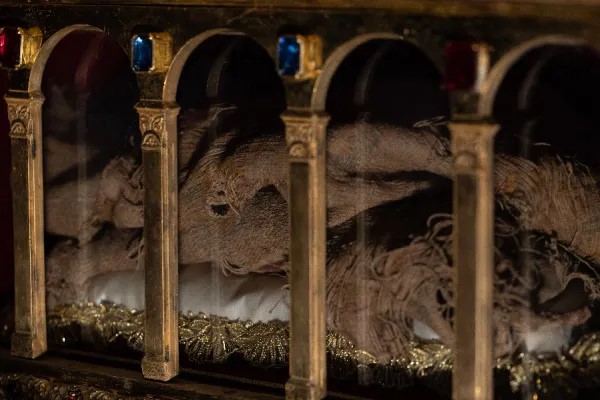
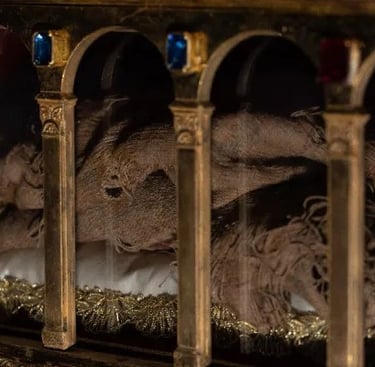
In the Basilica of Sant'Anastasia on the Palatine, we find a large piece of her cloak, present since the 4th century. This relic was reportedly brought to Rome by Saint Jerome, along with a fragment of the Virgin's veil. Both relics are inside a 17th-century reliquary, normally kept in a cabinet with a reinforced door. The reliquary is displayed only on special occasions.